
What exactly do we check?
We perform a detailed analysis of cryptocurrency addresses, checking for connections to over 20 potential risk sources. This helps us spot suspicious transactions and evaluate the risk level. To make our assessments more effective, we categorize all sources into three groups.
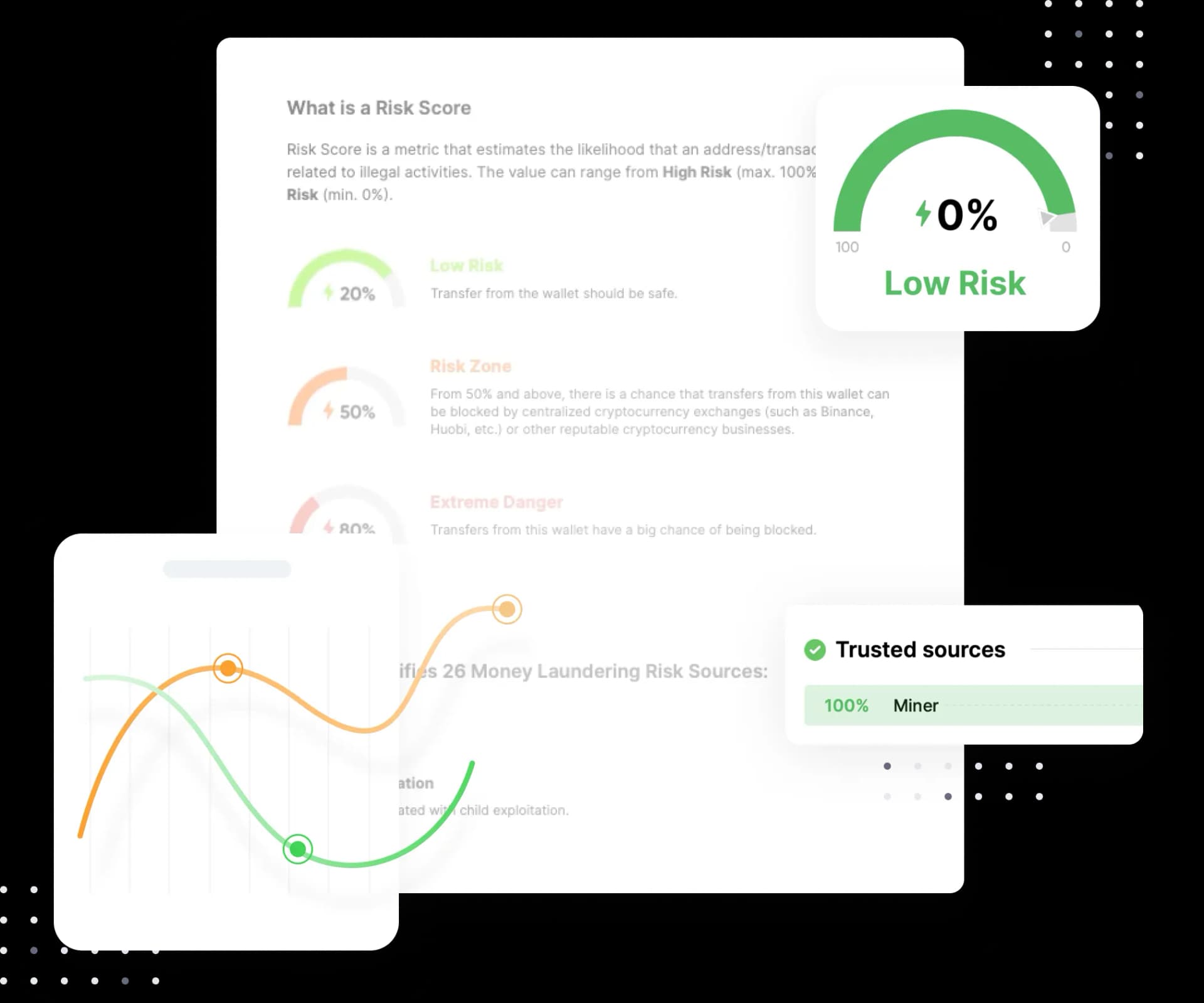
AML Risk Map
Categories of AML Check
We split risk sources into three levels to quickly assess exposure and make decisions on a wallet.
Danger Sources
Dark Market
Coins associated with illegal activities.
Dark Service
Coins related to child abuse, terrorist financing or drug trafficking.
Child Exploitation
Entities associated with child exploitation.
Enforcement action
The entity is subject to legal proceedings with the judicial authorities.
Fraudulent Exchange
Exchanges involved in exit scams, illegal behavior, or whose funds have been confiscated by government authorities.
Gambling
Coins associated with unlicensed online games.
Illegal Service
Coins associated with illegal activities.
Mixer
Coins that passed via a mixer to make tracking difficult or impossible. Mixers are mainly used for money laundering.
Ransom
Coins obtained by extortion or blackmail.
Sanctions
Entities subject to sanctions.
Scam
Coins that were obtained by deception.
Stolen Coins
Coins obtained by stealing someone else's cryptocurrency.
Terrorism Financing
Entities associated with terrorism financing.
Suspicious Sources
ATM
Coins obtained via cryptocurrency ATM operator.
Exchange | High Risk
An entity is considered high-risk based on the following criteria: No KYC: It does not require customer information before allowing deposits or withdrawals, nor does it verify any provided information. Criminal Ties: There are criminal charges against the entity related to AML/CFT violations. Impact: High exposure to risky services, such as darknet markets or other high-risk exchanges, is assessed if its exposure significantly exceeds the average of identified exchanges over the past 12 months. Jurisdiction: The entity operates in a jurisdiction with weak AML/CFT regulations. Unlicensed: It lacks a proper license to trade cryptocurrencies.
Liquidity Pools
The smart contracts where tokens are locked for the purpose of providing liquidity.
P2P Exchange | High Risk
The entity lacks a specific license to operate cryptocurrency exchange services, allowing participants to exchange directly without intermediaries. This also applies to licensed entities located in jurisdictions identified by the FATF as non-cooperative or those that do not require KYC for large-value transactions, making them appealing for money laundering activities.
Unnamed Service
This category pertains to currently unidentified clusters that display behaviors typical of a service, characterized by a substantial number of addresses and transactions.
TrustedSources
Exchange
The organization enables users to buy, sell, and trade cryptocurrencies under trading licenses that encompass the following service aspects: — Depository, brokerage, or other related financial services that facilitate exchanges where participants engage with a central party. This does not include: — Licenses for non-specific financial services or those from jurisdictions listed as non-cooperative by the FATF. These entities represent the most significant and widely used category in the cryptocurrency industry, accounting for 90% of all funds transacted through these services.
ICO
The organization funds its projects by selling newly minted cryptocurrency to investors in exchange for fiat currency or well-known cryptocurrencies like Bitcoin and Ether. While there are many legitimate examples of these offerings, numerous cases exist where bad actors have raised funds through ICOs, only to take the money and vanish.
Marketplace
Coins that were used to pay for legal activities.
Merchant Services
The entity enables businesses to accept payments from customers, commonly referred to as payment gateways or payment processors. It often facilitates conversions to local fiat currency and transfers the funds to the merchant's bank account.
Miner
Coins mined by miners and not forwarded yet.
Payment Processor
Coins related to payment services.
Seized Assets
Crypto assets seized by the government.
Wallet
An online wallet is a service for storing and transacting cryptocurrency. Hosted wallets, a type of online wallet, are custodial solutions where the service provider holds the user's private keys. While this can pose potential risks of scams or inadequate security, reputable providers often offer better protection than non-expert users.
P2P Exchange
The entity is licensed to operate specifically in providing cryptocurrency exchange services, allowing participants to exchange directly with each other without intermediaries. This does not include licenses for non-specific financial services or entities located in jurisdictions listed as non-cooperative by the FATF.
Other
Coins obtained through airdrops, token sales or other means.
Methodology for Analyzing Cryptocurrency
We use a wide range of data to analyze cryptocurrency wallets. The main aspects of our methodology include:
Historical Transaction Data
We analyze previous transactions associated with the address to identify suspicious patterns.
Comparison with Known Risk Sources
We compare the addresses we're investigating against extensive databases that include information about fraud schemes, sanctions, and other risks.
Algorithmic Analysis
We apply machine learning algorithms to identify anomalies and high-risk transactions, which helps improve classification accuracy.
Contextual Information
We consider factors such as jurisdiction, types of services, and the reputation of market participants to make informed decisions about classifying addresses.
What is the price of your peace of mind?
Start
$3
$3 per check
Perfect for trying out the service
- 1 AML check, unlimited in time
- 24/7 Priority Service
Optimal
$25
$2.5 per check
Advantageous package for holders
- 10 AML checks, unlimited in time
- 24/7 Priority Service
Pro
$50
$2.5 per check
For traders and investors
- 25 AML checks, unlimited in time
- 24/7 Priority Service
Please contact us at who [email protected] if you need more checks. Your dedicated manager is ready to provide you with the best options and answer any questions you may have!